John Lawson’s death and Shane Alworth’s identity substitution
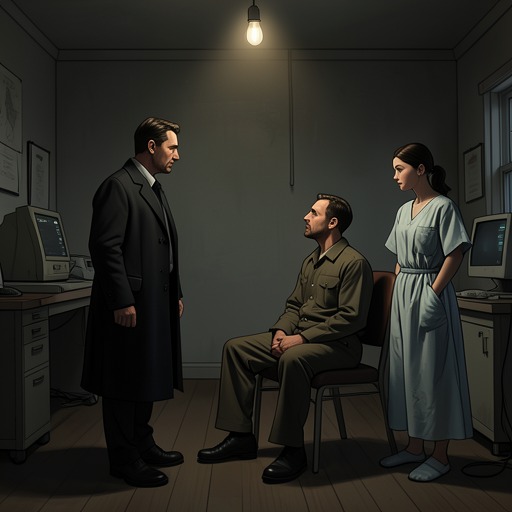
Just One LookJohn Lawson’s death and Shane Alworth’s identity substitution is the history Grace Lawson pieces together when she confronts Sandra Koval about the identity of her husband, Jack Lawson. Grace’s case joins a reported shooting, the absence of a scar, and the voting rules of the Lawson family trust into a possible explanation for how Shane came to live as John. The confrontation makes the substitution seem increasingly plausible, but its crucial details remain Grace’s reconstruction: Sandra does not confess, and she challenges whether the arrangement amounted to a crime.
The shooting and the missing scar
The immediate basis for Grace’s account is that Jimmy X and Gordon MacKenzie both said John Lawson was shot on the night of the concert. Sandra confirms that her brother was shot and says he spent three weeks in a hospital, naming Mass General when Grace asks where. The exchange initially appears to settle a fact about John’s fate. Instead, Grace uses it to test whether the man she married could have been him.
Grace says she did not need to check every hospital in the Boston area because Jack had no scar. In her reasoning, a bullet wound would have left one; the absence of that mark therefore contradicts the claim that her husband was the wounded John. She presents the discrepancy as simple logic, but her hands are trembling as she lays out what it means: she had not been married to Sandra’s brother. The bodily evidence is small and specific, yet it overturns the identity on which years of family life had rested.
Grace’s alternative is that John’s wounds were lethal. She says Sandra and Sheila Lambert helped drag him out during the melee, then argues that taking him to a hospital would have required reporting the shooting. A dead body—or even a body abandoned in the street—could also have drawn an investigation connecting the violence to the concert. Grace frames Sandra’s supposed fear as both personal and public: she was a promising lawyer, while the Boston district attorney, Carl Vespa, and the families were demanding accountability. This is Grace’s explanation of why the shooting might have been concealed, not a confirmed account of what Sandra did afterward.
The proposed identity substitution
Grace identifies her own husband as Jack Lawson, formerly known as Shane Alworth. In her reconstruction, Eric Wu had not held two men in the basement but one: Jack, who had sacrificed himself to save Grace and may have wanted to leave a final truth behind. That realization connects the immediate danger of Jack’s captivity to the older concealed history. Grace treats the identity as the answer to the contradiction between Sandra’s account of John’s hospital stay and her husband’s unmarked body.
The practical means of the substitution, as Grace describes them, depended on cooperation and paperwork. She suggests that Sandra and her father could have helped Shane obtain identification using John’s birth certificate and other documents, perhaps explaining away a new face by claiming John’s wallet had been stolen. Grace notes that screening was easier at the time and that John had already graduated from Vermont University, so Shane would not have needed to appear there as the same person. She also points to a change from a Los Angeles trust lawyer to a new lawyer in Boston who would not know John’s appearance. In this account, the family’s presence and apparently proper identification could make the impersonation pass without inviting questions.
Grace further proposes that Shane could travel overseas and, if challenged, use Jack or explain that he was another John Lawson. The commonness of the name would, in her theory, offer another layer of cover. These details describe how Grace believes the substitution could have worked; they do not establish that each step occurred. She says old photographs and a DNA test could prove that her husband was not Sandra’s brother, and insists that the case could be demonstrated even if Sandra remained silent.
The trust and the possible motive
The family trust gives Grace’s theory a financial and political dimension. She says she found trust papers in Jack’s desk and took them to a lawyer friend. According to her account of the documents, the grandfather established six trusts for his two children and four grandchildren. The voting shares were divided among the six, with the father receiving an additional four percent; together, Sandra’s side of the family retained control of the business by fifty-two percent to forty-eight.
The terms Grace describes also provided for a redistribution if one of the beneficiaries died before age twenty-five: the voting power would be divided equally among the five survivors. If John had died on the concert night while still within that age limit, Grace reasons, Sandra and her father would lose their majority position. She does not claim certainty about Sandra’s motive. Rather, she offers fear of exposure and fear of losing control of the business as possible pressures that might have converged. The trust clause turns the concealment from an effort to avoid investigation into a possible means of preserving family control.
Grace imagines that Shane’s own circumstances could have made him vulnerable to recruitment. She cites his mother’s account that the family was very poor, his brother Paul could not afford college, and his mother lived in a dilapidated home. Grace speculates that Sandra may have threatened consequences for the members of Allaw if one of them was implicated. The conversation does not verify a threat or establish how Shane agreed to assume John’s identity; it exposes the distance between the resources Grace believes the Lawson family possessed and the limited choices she suspects Shane faced.
What the confrontation leaves unresolved
Sandra does not confirm Grace’s account. She asks whether Grace expects her to break down and confess, then says she is not sure she sees a crime in what Grace has described. Her response neither supplies the missing sequence nor resolves whether John died from his wounds, what happened to his body, or exactly how Shane became Jack. Grace, for her part, acknowledges that her explanation may be wrong, while maintaining that photographs and DNA could establish the identity difference.
The event therefore reaches a decisive shift in what Grace believes without producing a complete public confession. Jack’s name, which had seemed to identify her husband and connect him to Sandra’s family, becomes evidence of an assumed identity; the absent scar and the trust papers become clues in the same reconstruction. Yet the distinction between a persuasive theory and an admitted fact remains essential. The confrontation brings John’s reported shooting, Shane’s possible substitution, and the family’s voting interests into one causal account, while leaving Sandra’s responsibility and the precise circumstances of John’s death contested.